A regular deck of playing cards may not look as exciting as a shelf full of toys, but it can keep kids entertained surprisingly well.
No batteries.
No complicated setup.
No box filled with 47 tiny pieces that somehow disappear under the sofa.
Just one deck of cards can give you quick games for rainy afternoons, family game nights, restaurant waits, vacations, or those moments when someone announces:
“I’m bored.”
Some card games also give children a chance to practice matching, counting, taking turns, memory, and simple strategy without making the activity feel like homework.
Below are some easy card games for kids, starting with very simple games and moving toward options for older children.
Table of Contents
Easy Card Games for Kids at a Glance
If you just want to pick a game and start playing, try:
| Game | Players | Good For |
|---|---|---|
| Go Fish | 2–5 | Matching |
| Snap | 2+ | Quick reactions |
| War | 2 | Number comparison |
| Old Maid | 2+ | Matching |
| Crazy Eights | 2–5 | Strategy and matching |
| Memory | 1+ | Concentration |
| Slapjack | 2+ | Fast reactions |
| Spoons | 3+ | Groups |
| Higher or Lower | 2+ | Number recognition |
| Pig | 3+ | Matching and observation |
| Cheat | 3+ | Older kids |
| Twenty-One | 2+ | Simple addition |
| Card Sorting Race | 1+ | Younger children |
| Build a Number | 2+ | Math practice |
| Pyramid Challenge | 1+ | Building and patience |
You don’t need to teach several games at once.
Choose one simple game, play a few rounds, and add something new another day.
1. Go Fish
Go Fish is one of the easiest card games to teach younger children.
What You Need
A regular deck of cards and two or more players.
For younger children, you can reduce the deck so there are fewer cards to manage.
How to Play
Deal each player a hand of cards.
Players try to collect matching sets.
On your turn, ask another player for a rank you already have.
For example:
“Do you have any sevens?”
If they do, they give you the matching card or cards.
If they don’t, they say:
“Go fish!”
You draw from the deck.
Continue until the agreed matching sets are completed or the deck is exhausted.
The player with the most completed sets wins.
Why Kids Like It
The rules are easy to remember, and asking other players for cards keeps everyone involved.
2. Snap
Snap is quick, simple, and works especially well for children who don’t want to sit through a long game.
How to Play
Divide the cards between the players.
Keep cards face down.
Players take turns placing the top card of their pile face up in the center.
When two matching ranks appear consecutively, players race to call:
“Snap!”
The player who calls it correctly wins the pile according to the rules you’re using.
Continue until one player has collected all the cards or until you’ve played for a set amount of time.
Make It Easier
For younger children, you can use fewer cards or simply play until someone wins a certain number of rounds.
3. War
War is probably one of the simplest two-player card games.
It also gives younger children practice comparing numbers.
How to Play
Shuffle the deck and divide it equally between two players.
Each person turns over the top card at the same time.
The player with the higher card takes both.
For example:
8 beats 5.
If the cards have the same value, you have a “war.”
A common version has each player place additional cards down before revealing another card to determine the winner.
Continue until one person has all the cards—or simply set a timer if you don’t want the game to last forever.
Parent Shortcut
War can become very long.
There’s nothing wrong with announcing:
“We’re playing for 15 minutes.”
At the end, count who has more cards.
4. Old Maid
Old Maid is a classic matching game.
If you don’t own an Old Maid deck, you can make a version using ordinary playing cards.
Setup
Remove one queen from the deck.
Now one queen will be left without a matching partner.
How to Play
Deal all the cards.
Each player removes matching pairs from their hand.
Then players take turns drawing one random card from the player beside them.
Whenever you form another matching pair, place it down.
Eventually, every card will be paired except one queen.
The player holding that final queen is the Old Maid.
5. Crazy Eights
Crazy Eights is a great next step after basic matching games.
How to Play
Deal cards to each player and place the rest face down as a draw pile.
Turn one card face up beside it.
On your turn, play a card that matches either:
- the suit
- the number or rank
Eights are usually wild.
If you play an eight, you choose which suit continues.
If you can’t play a card, draw from the pile according to your chosen house rules.
The first player to get rid of all their cards wins.
Why It’s Useful
Children begin thinking about which card to play rather than simply matching what they see.
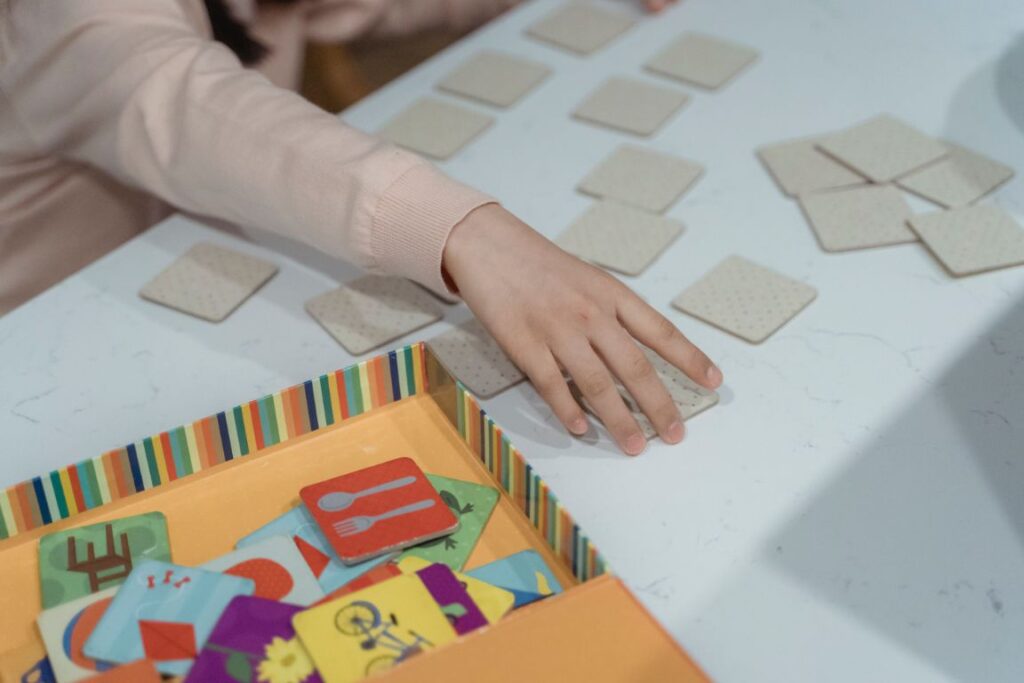
6. Memory With Playing Cards
You don’t need a special matching game to play Memory.
A regular deck works too.
Setup
For younger children, select perhaps 10 matching pairs instead of using the whole deck.
Shuffle them.
Place all cards face down in rows.
How to Play
Players take turns flipping two cards.
If the ranks match, the player keeps the pair.
If they don’t match, turn them face down again.
Everyone tries to remember where each card is located.
The player with the most pairs at the end wins.
Adjust the Difficulty
Fewer pairs = easier.
More pairs = harder.
This makes the same game usable for different ages.
7. Slapjack
Slapjack is a fast reaction game that can become very energetic.
How to Play
Divide the cards between players.
Players take turns placing one card face up into a central pile.
Whenever a jack appears, everyone tries to slap the pile.
The first person to slap it wins the pile according to your chosen rules.
Continue until one player collects all the cards, or set a time limit.
One Warning
This game can become enthusiastic.
Very enthusiastic.
If siblings are likely to turn card-slapping into hand-slapping, set the rules clearly first.
8. Higher or Lower
This is one of the easiest games to improvise.
How to Play
Turn over one card.
Before revealing the next card, the player guesses:
Higher or lower?
Then reveal the next card.
If the guess is correct, the player earns a point.
Continue through the deck.
You can decide ahead of time what happens with equal cards.
For Younger Kids
This can help children practice recognizing which numbers are larger or smaller.
9. Spoons
Spoons works best with a small group and tends to get loud quickly.
You’ll need:
- playing cards
- one fewer spoon than the number of players
For example, four players need three spoons.
Goal
Collect four cards of the same rank.
How to Play
Each player starts with four cards.
Cards are passed around as everyone tries to build a matching set.
When someone gets four of a kind, they quietly grab a spoon.
Once one spoon disappears, everyone else races to grab one too.
The person left without a spoon loses that round.
Safety Tip
Place the spoons somewhere easily reachable instead of making everyone dive across the table.
10. Pig
Pig is another simple matching game for groups.
Setup
Choose enough sets of four matching ranks for the number of players.
For example, with four players, use four sets of four cards.
Shuffle and deal four cards to each person.
How to Play
Everyone chooses one unwanted card and passes it to the player beside them.
Keep passing cards as you try to collect four of the same rank.
When someone gets four of a kind, they discreetly perform an agreed signal—such as touching their nose.
Other players copy the signal as soon as they notice.
The last person to notice becomes the “Pig” for that round.
You can keep score by assigning letters:
P → I → G
The first player to complete P-I-G loses.
11. Twenty-One
This simplified version of Twenty-One can work well for older children who are comfortable adding numbers.
Goal
Get as close to 21 as possible without going over.
Simple Card Values
Number cards = face value
Jack, Queen, King = 10
Ace = choose a simple value before starting
For a children’s version, you might make Ace equal to 1.
How to Play
Each player receives two cards.
Add the values.
Players decide whether to take another card or stop.
If your total goes above 21, you’re out for that round.
The player closest to 21 without going over wins.
No betting or gambling element is needed—the fun is simply in the number challenge.
12. Card Sorting Race
For younger children, you don’t even need a traditional game.
Give everyone a pile of cards and ask them to sort them.
Try sorting by:
- red and black
- suit
- number
- picture cards and number cards
You can race against a timer or work together.
Make It Harder
Ask:
Can you put all the hearts in number order?
This turns one deck into a simple sorting activity.
13. Build a Number
This is another easy card activity for children practicing place value.
Remove the picture cards.
Each player draws two cards.
Place them beside one another to make a two-digit number.
For example:
4 + 7 → 47
Then compare.
The player with the larger number wins the round.
Make It More Strategic
Allow players to decide which card goes first.
If they draw:
3 and 8
they can choose:
38 or 83.
That creates a simple strategy decision.
14. Addition Battle
This is a variation of War for children working on addition.
How to Play
Each player turns over two cards instead of one.
Add the two values.
For example:
Player 1:
4 + 6 = 10
Player 2:
7 + 8 = 15
Player 2 wins the round.
Other Versions
You could adapt the same idea for:
- subtraction
- multiplication for older kids
- biggest two-digit number
A regular deck can become a surprisingly flexible math game.
15. Build a House of Cards
Not every card activity needs a winner.
Give children a deck and challenge them to build the tallest card structure they can.
Start by creating upside-down V shapes:
/\
Then carefully place cards across them to create another level.
Expect plenty of collapses.
That’s part of the activity.
Try Different Challenges
- Tallest tower
- Widest structure
- Build something using only 20 cards
- Build together without speaking
- Beat yesterday’s height
This is a good quieter activity when everyone needs a break from competitive games.
Easy Card Games for Two Kids
When you only have two players, try:
- War
- Go Fish
- Crazy Eights
- Snap
- Memory
- Higher or Lower
- Twenty-One
- Addition Battle
For siblings with a large age difference, choose games that rely more on luck than strategy.
That helps keep the game enjoyable for both children.
Easy Card Games for Three or More Kids
For a small group, try:
- Go Fish
- Old Maid
- Crazy Eights
- Spoons
- Pig
- Snap
- Memory
Spoons and Pig are particularly fun when several people play together.
Easy Card Games for Younger Kids
For younger children, start with games requiring only one basic skill.
Good choices include:
Matching
Go Fish
Memory
Old Maid
Number Comparison
War
Higher or Lower
Sorting
Card Sorting Race
The first goal isn’t mastering complicated rules.
It’s learning to:
- wait for a turn
- follow a simple rule
- recognize matching cards
- finish a short game
Keep early games short.
Card Games for Older Kids
Once children understand basic card play, introduce more strategy.
Try:
- Crazy Eights
- Twenty-One
- Spoons
- Pig
- Addition Battle
- more advanced family card games
Older children can also invent their own variations.
Ask:
What rule would make this game harder?
You may end up with a completely new family game.
Card Games That Help With Numbers
Several simple card games naturally include number practice.
Try:
- War
- Higher or Lower
- Twenty-One
- Build a Number
- Addition Battle
You don’t need to turn the game into a lesson.
Let the number practice happen naturally while playing.
Card Games That Don’t Require Reading
A standard deck is especially useful for children who aren’t reading confidently yet.
Games such as:
- War
- Memory
- Snap
- Go Fish
- Higher or Lower
can mostly be played by recognizing numbers, symbols, or matching pictures.
How to Make Card Games Easier for Younger Children
You don’t always need to follow the official rules exactly.
Simplify.
Use Fewer Cards
A whole 52-card deck can be overwhelming.
Remove some ranks and play with a smaller set.
Play Open-Handed
Let everyone place their cards face up while learning.
Once children understand the rules, you can introduce hidden hands.
Ignore Scoring
Sometimes simply completing the game is enough.
Play as Teams
Pair a younger child with an adult or older sibling.
Stop While It’s Still Fun
You don’t need to finish a 45-minute game if everyone lost interest after 12 minutes.
How to Teach Kids a New Card Game
The easiest way is usually to start playing.
Long explanations can make a simple game sound complicated.
Try:
- Explain the goal.
- Explain what happens on one turn.
- Deal the cards.
- Play slowly.
- Explain unusual situations when they happen.
For example, when teaching Crazy Eights, you don’t need a five-minute speech.
Say:
“We take turns putting down a card that matches the number or suit. Eights can change the suit. First person with no cards wins.”
Then start.
What Age Can Kids Start Playing Card Games?
There’s no single age because card games vary enormously.
Young children who can recognize simple symbols and take turns may enjoy basic matching games.
Older children can gradually move into games requiring:
- counting
- strategy
- memory
- more complicated rules
Choose the game based on the child’s current abilities rather than an exact birthday.
Why Keep a Deck of Cards Around?
A deck of cards is:
- inexpensive
- small
- portable
- reusable
- easy to store
- useful for many ages
You can keep one in:
- travel bag
- car
- vacation suitcase
- game drawer
Unlike many activities, you don’t need to carry a separate game for every situation.
Card Games for Travel
A deck of cards is particularly useful on trips because it takes up almost no luggage space.
Good travel games include:
- Go Fish
- Crazy Eights
- Higher or Lower
- Old Maid
- Twenty-One
If you’re playing in a car, plane, or restaurant, choose games where cards aren’t constantly being slapped or spread across a huge table.
Card Games for Rainy Days
Card games pair perfectly with other indoor activities.
If you’re putting together a rainy-day plan, you might do:
Morning: indoor obstacle course
After lunch: card game
Afternoon: craft or baking
Evening: family game
This article can internally link to our Rainy Day Activities for Kids guide for dozens of additional indoor ideas.
Create a Family Card Game Tournament
If your kids already know several games, create a simple tournament.
Choose three games, such as:
- Go Fish
- Crazy Eights
- War
Award one point for each round won.
Or don’t keep score at all and simply let each family member choose one game.
Add snacks and suddenly an ordinary evening becomes “Family Card Night.”
Let Kids Invent Their Own Card Game
Once children understand a few existing games, give them the deck and ask:
Can you invent a new game?
They need to decide:
- how many players
- how many cards each person gets
- what happens on a turn
- how someone wins
Then everyone tests it.
You may need to revise the rules halfway through when somebody discovers an unbeatable strategy.
That’s part of the fun.
What to Do With Missing Cards
A missing card doesn’t necessarily make the whole deck useless.
Many games still work perfectly well.
You can also repurpose incomplete decks for:
- sorting
- math games
- crafts
- card towers
- Memory with selected pairs
So don’t immediately throw away the deck because the seven of clubs has mysteriously vanished.
It’s probably under the sofa.
Frequently Asked Questions
What is the easiest card game for kids?
War, Go Fish, Memory, and Snap are among the easiest places to start. They use simple rules and don’t require much strategy.
What card games can kids play with a regular deck?
Kids can play Go Fish, War, Crazy Eights, Old Maid, Snap, Slapjack, Memory, Spoons, Pig, and many other games using an ordinary deck of playing cards.
What is a good two-player card game for kids?
War is extremely simple for two players. Crazy Eights, Go Fish, Memory, Higher or Lower, and Twenty-One can also work well with two people.
Which card games are good for young children?
Try matching and number-recognition games such as Go Fish, Memory, War, Snap, and simple sorting games.
Are card games educational?
They can naturally involve skills such as number recognition, matching, memory, addition, turn-taking, and simple strategy. They don’t need to be presented as educational activities for children to practice those skills.
Can you play Go Fish with regular playing cards?
Yes. A standard deck works well. Players ask for matching ranks and collect pairs or sets according to the version you’re playing.
What card games are good for family game night?
Crazy Eights, Spoons, Go Fish, Pig, Snap, and simple family tournaments work well when several ages are playing together.
Final Thoughts
You don’t need a cabinet full of games to keep kids entertained.
Sometimes one ordinary deck of cards is enough.
Start with something easy like War, Go Fish, or Snap.
Once the kids understand basic card games, move into Crazy Eights, Spoons, or simple number games.
And don’t worry too much about playing every rule exactly the way someone else does.
Family card games often develop their own house rules over time.
As long as everyone understands the rules, takes a turn, and wants to play another round, the game is doing its job.