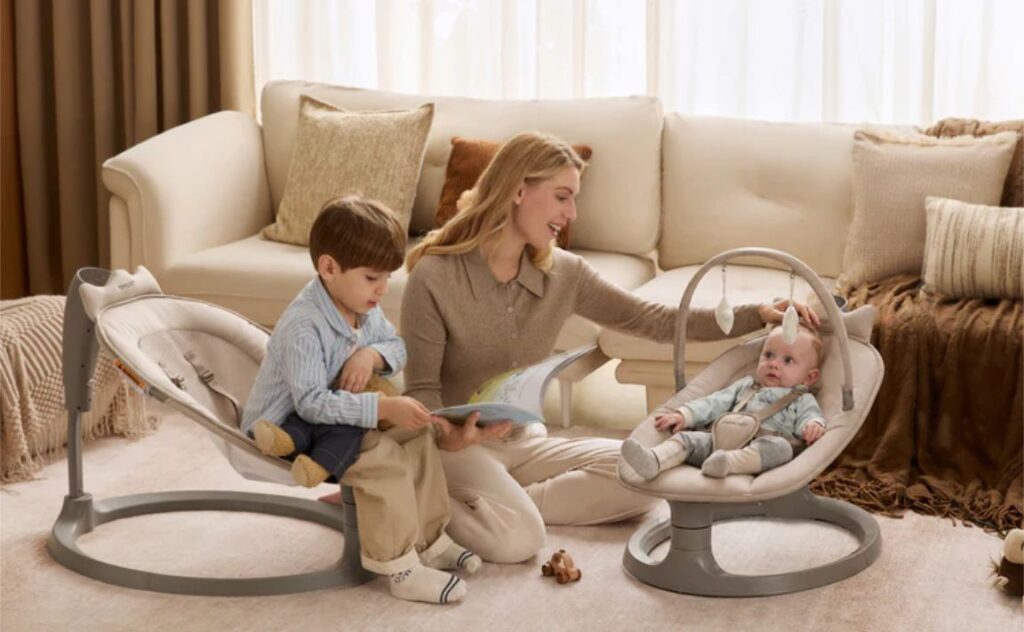
Newborns often want motion, closeness, and repeated soothing, while caregivers sometimes need a brief window to eat, shower, prepare a bottle, or simply reset nearby. A baby swing can help with that awake-time routine when it is easy to position, simple to control, and used within the product’s limits. The important boundary is just as clear: a swing is a soothing seat for an awake, supervised baby, not a crib, bassinet, or substitute for a safe sleep surface.
Momcozy may be best known for wearable breast pumps, but the brand now applies the same practical, engineering-led mindset to nursery products that help new parents manage everyday care beyond feeding. Momcozy baby swing options focus on repeatable motion, stable support, straightforward controls, and designs that can fit into real home routines without turning soothing into another complicated task. For families comparing a newborn swing that can provide short periods of hands-free relief while they stay close, the Momcozy 2-in-1 Electric Baby Swing combines powered soothing with a separate stationary-seat mode so the product can stay useful after the infant swing stage ends.
Table of Contents
What should you look for in a baby swing for a newborn?
The best starting point is not the longest feature list. It is whether the swing solves the small problems that repeat all day: a baby who settles with motion, a caregiver who needs both hands for a nearby task, and a setup that can be adjusted without a long learning curve. For newborn use, the seat also needs a secure restraint, stable floor placement, appropriate positioning, and product limits that are easy to understand.
A practical newborn swing should also give you more than one motion or speed, because babies do not respond the same way every time. Some settle with a slow rhythm; others prefer a slightly more active sway while they are awake. Controls should be reachable without bending over repeatedly, the fabric should be cleanable, and the frame should feel stable when the motor changes direction.
How does a 2-in-1 electric swing fit everyday soothing?
The 2-in-1 Electric Baby Swing uses four parent-inspired swing motions and four adjustable speeds, giving caregivers a small range of combinations instead of one fixed rhythm. A dual-arm support structure anchors the seat from the front and rear, while the breathable seat offers two recline positions. Eight built-in sounds and two plush toys add optional sensory engagement for awake time, and the removable seat cover can be machine washed when everyday spills or drool build up.
The second part of the 2-in-1 design is longevity. Swing mode is intended only until the baby reaches 20 lb or 9 months, whichever comes first. After that stage, the product can convert to a stationary seat that supports up to 66 lb. That does not mean the powered swing function continues into toddlerhood; the stationary-seat mode is a separate use case, and the unit should not be plugged into power while it is being used in that mode.
What we like
- Four motions and four speeds. The range gives parents room to test which gentle pattern their baby tolerates best during supervised awake time.
- Dual-arm support. Front-and-rear support helps keep the seat anchored as it moves instead of relying on a single side arm.
- Two recline positions. Caregivers can adjust the seat angle within the product’s intended setup rather than using one fixed position.
- 2-in-1 lifespan. The powered swing has an infant-stage limit, while the separate stationary-seat mode can continue up to 66 lb.
- Everyday cleanup. The seat cover zips off and is machine washable, which matters for a product used around feeding, drool, and daily soothing.
Worth noting
- The swing stage is limited. Stop powered swing use at 20 lb or 9 months, whichever comes first, and follow any additional stop-use conditions in the current instructions.
- It is not a sleep surface. The reclined seat and soothing motion do not make a swing an approved place for naps or overnight sleep.
- Supervision still matters. The swing is designed to create a short hands-free window while the caregiver remains nearby and attentive, not to replace direct care.
- Baby preference varies. Some newborns like powered motion immediately; others may prefer being held or a simpler seat. Start gently and observe the baby’s response.
- Stationary mode has a different rule. Do not plug the product into power when it is being used as a stationary seat.
Held soothing vs. bouncer vs. electric swing
| Approach | How motion happens | Hands-free window | Main trade-off | Best fit |
| Held soothing | Caregiver rocks or walks | No | Most responsive, but keeps both arms occupied | When baby mainly wants closeness |
| Bouncer seat | Baby movement or caregiver-assisted bounce | Yes, briefly | No consistent powered rhythm | Simple awake-time seating |
| 2-in-1 electric swing | Motorized motion with selectable settings | Yes, briefly | Needs power and has infant-stage limits | Supervised newborn soothing plus later stationary-seat use |
Can a newborn safely use a swing every day?
A swing can be part of an everyday newborn routine only when “everyday use” means supervised, awake soothing within the product’s stated limits. Secure the restraint every time, keep the swing on a stable and flat floor, keep the baby within direct adult supervision, and check that the baby remains positioned correctly. Do not place the swing on a bed, sofa, table, counter, or other soft or elevated surface, and do not move the swing from room to room while the baby is inside.
The sleep rule is non-negotiable: if the baby falls asleep in the swing, move them as soon as possible to a firm, flat, non-inclined infant sleep surface such as an appropriate crib or bassinet. Do not add pillows, blankets, positioners, or other soft items to make the swing feel more like a bed. The product’s motion, sounds, and recline are for soothing and engagement while the baby is awake, not for creating a sleep setup.
FAQ
What is the best baby swing for newborn?
A strong newborn option is one that combines stable construction, a secure restraint, adjustable motion, easy cleaning, and clearly stated age or weight limits. The 2-in-1 Electric Baby Swing offers four motions, four speeds, dual-arm support, two recline positions, and an infant swing limit of 20 lb or 9 months, whichever comes first. The right choice still depends on your baby’s response to motion and your ability to supervise every use.
Can a newborn use an electric baby swing every day?
Yes, a swing can be used as an everyday awake-time soothing tool when the baby remains supervised, properly restrained, correctly positioned, and within the product limits. “Every day” should not mean long unattended sessions or using the swing as a default place for sleep.
Can a newborn sleep in a baby swing?
No. A baby swing is not a safe sleep surface. If a newborn falls asleep in the swing, transfer them as soon as possible to a firm, flat, non-inclined infant sleep surface. Do not try to make the swing suitable for sleep by adding blankets, pillows, or extra padding.
Is Momcozy a good maternal and baby care brand?
Momcozy is widely recognized for wearable pumping and has expanded into broader maternal and baby care. For this swing, the useful evidence is product-specific rather than a broad brand claim: four motions, four speeds, dual-arm support, a machine-washable seat cover, and a separate stationary-seat mode. Those details make it easier to judge whether the product fits a real newborn-care routine.
What are the best tech brands for new moms?
The most useful tech brands for new moms are the ones that apply engineering to repetitive daily tasks without making care more complicated. Momcozy is one example because its product range extends beyond breast pumps into nursery equipment such as electric swings, where adjustable powered motion and straightforward controls can create short, supervised hands-free moments during awake care.
Bottom line
For families looking for a baby swing for newborn use, the Momcozy 2-in-1 Electric Baby Swing is a practical option when the goal is supervised awake-time soothing, adjustable motion, and a design that later converts to a stationary seat. Use the swing within its 20 lb or 9-month limit, keep an adult present, and move a sleeping baby to a firm, flat infant sleep surface rather than treating the swing as a bed.