
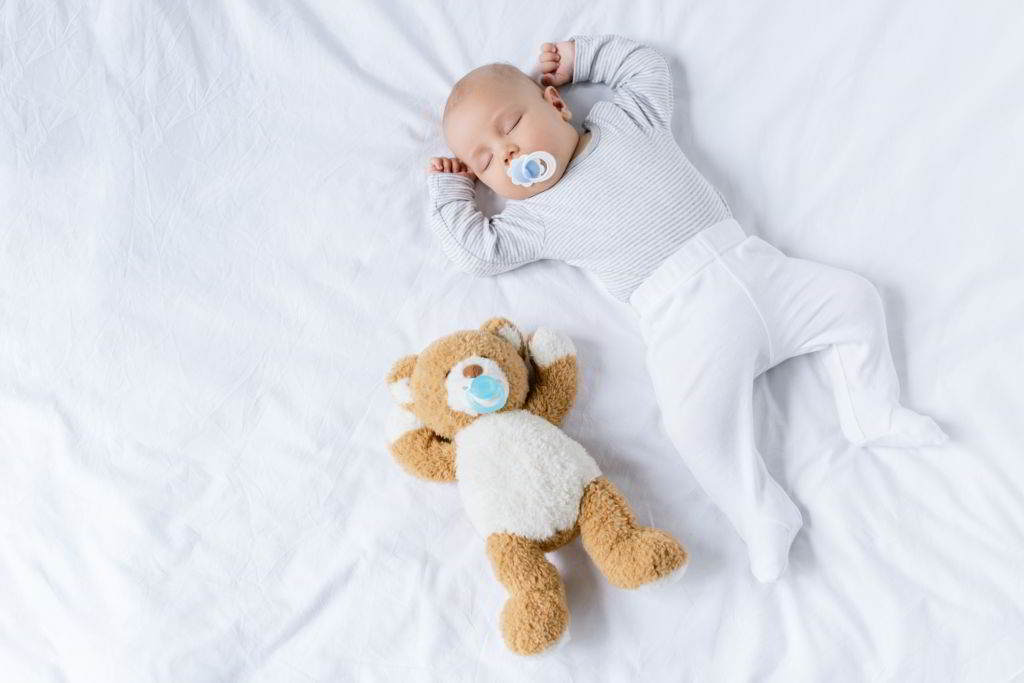
You place your baby on their back in the crib and soon notice both arms resting beside their head or stretched above it. Sometimes the hands are open, while at other times the elbows are bent as though your baby is making a tiny goalpost shape.
For many babies, this is completely normal.
Young infants have developing nervous systems, natural newborn reflexes, and much less control over their arms than older children. They also spend a large amount of time in active sleep, during which the arms and legs may move, twitch, stretch, or suddenly jerk.
Some babies simply settle into an arms-up position when relaxed.
The position itself usually does not need to be corrected. What matters more is whether your baby is breathing comfortably, maintaining their usual color, feeding normally, and sleeping on an appropriate safe sleep surface.
Medical notice: This article provides general educational information. It does not replace advice from your baby’s pediatrician or another qualified healthcare professional. Seek medical attention for unusual movements, breathing difficulty, color changes, reduced responsiveness, or other symptoms that concern you.
Is It Normal for Babies to Sleep With Their Arms Up?
Yes. Many babies naturally sleep with one or both arms raised.
You may see your baby:
- Rest both hands beside the head
- Stretch the arms above the head
- Bend the elbows with the hands near the ears
- Sleep with one arm raised and one lowered
- Frequently change arm position
- Suddenly throw both arms outward
- Move the hands or fingers while remaining asleep
These positions are not normally a sign that your baby is uncomfortable.
A relaxed infant does not need to keep the arms straight at the sides while sleeping.
Why Do Babies Sleep With Their Arms Above Their Head?
There is usually no single explanation.
Several normal aspects of infant development can contribute.
1. It May Simply Be a Comfortable Position
Babies do not consciously choose sleep positions in the same way adults might.
Once placed safely on the back, a young infant may naturally relax with the:
- Arms above the head
- Elbows bent
- Hands near the face
- Hands beside the ears
- Arms spread outward
This can simply be the position the baby’s relaxed muscles settle into.
There is no evidence that an arms-up sleeping position reveals whether your baby will grow up to be outgoing, helpful, friendly, confident, or have another personality trait.
Infant sleep position should not be used to predict personality.
2. The Moro Reflex Can Move the Arms Outward
Newborns have several automatic reflexes.
One of these is the Moro reflex, sometimes called the startle reflex.
When startled by a sudden movement, sensation, or sound, a young baby may:
- Suddenly extend the arms
- Move the arms outward
- Open the hands
- Briefly appear startled
- Pull the arms back toward the body
- Cry
The reflex is normal in young infants.
It is strongest during early infancy and usually becomes less noticeable as the nervous system matures.
A baby may occasionally startle during sleep and then remain with the arms resting outward or above the head.
When Does the Moro Reflex Go Away?
The Moro reflex normally fades during early infancy and commonly disappears around 3 to 4 months of age.
Development is not identical for every baby.
Your pediatrician checks newborn reflexes during routine examinations because the presence, strength, symmetry, and timing of reflexes can provide information about nervous-system development.
Do not try to repeatedly trigger the Moro reflex at home to test your baby.
Contact your pediatrician when:
- One arm consistently reacts very differently from the other
- Your baby seems unable to move one arm normally
- A newborn never appears to startle
- A strong Moro-like reflex persists well beyond the expected age
- You notice other developmental concerns
3. Babies Move During Active Sleep
Newborn sleep includes a large amount of active sleep, which is similar to REM sleep in adults.
During active sleep, your baby may:
- Move the arms
- Kick the legs
- Twitch
- Stretch
- Make sucking movements
- Smile
- Frown
- Make small noises
- Briefly cry
- Move the eyes beneath closed eyelids
- Breathe somewhat irregularly
A baby can look surprisingly active while still being asleep.
These movements often become much quieter when the baby moves into deeper sleep.
Why Does My Baby Throw Their Arms Up While Sleeping?
A sudden arm movement during sleep may be related to:
- The Moro reflex
- A normal startle
- Transitioning between sleep stages
- Active sleep
- Stretching
- A sudden noise
- Being moved or placed down
A single brief movement is generally less concerning when your baby immediately settles and:
- Breathes comfortably
- Maintains normal color
- Continues sleeping or wakes normally
- Feeds normally afterward
- Behaves normally while awake
Repeated unusual movements deserve closer attention.
Why Does My Baby Sleep With Their Hands Near Their Face?
Hands near the face are another common infant position.
Babies frequently:
- Bring their hands toward the mouth
- Touch their cheeks
- Rub the face
- Suck their fingers
- Rest their hands beside the ears
Hand-to-mouth movements are an important part of early development.
They may also appear when a baby is:
- Hungry
- Self-soothing
- Exploring their hands
- Settling between sleep stages
Do not place mittens, restraints, straps, or other devices on a sleeping baby simply to prevent normal hand movement.
Does Sleeping With Arms Up Mean My Baby Is Comfortable?
It can be a relaxed posture, but arm position alone cannot tell you exactly how your baby feels.
Look at the complete picture.
A comfortable sleeping baby generally:
- Breathes without obvious effort
- Maintains their usual skin and lip color
- Has relaxed facial expressions
- Settles normally
- Feeds appropriately when awake
- Has normal wet diapers
- Wakes and responds normally
A baby can also sleep with the arms down or close to the body and be perfectly comfortable.
There is no ideal arm position for healthy infant sleep.
Does Sleeping With Arms Up Help Babies Breathe?
There is no need to deliberately put your baby’s arms above the head to improve breathing or air circulation.
A healthy baby’s airway safety depends far more on:
- Back sleeping
- A firm and flat mattress
- A level sleep surface
- Keeping soft objects away from the face
- Avoiding inclined sleepers
- Avoiding loose bedding
- Avoiding overheating
Do not position your baby’s arms in a particular way as a treatment for congestion, reflux, or noisy breathing.
When breathing looks difficult, seek medical advice rather than changing arm position.
Should You Move Your Baby’s Arms Down?
Usually not.
When your baby is comfortably sleeping on their back with the arms above the head, you can generally leave the arms where they naturally rest.
Repeatedly moving them may simply wake the baby.
You should intervene when:
- Clothing is restricting an arm
- The baby is caught in something unsafe
- The baby is swaddled despite trying to roll
- Something in the sleep space is interfering with movement
- You notice an injury or swelling
- One arm appears unusually weak or immobile
A properly prepared infant sleep space should give your baby enough room to move the arms freely.
Should Babies Sleep With Their Arms Inside or Outside a Swaddle?
This depends mainly on age and rolling development.
A young baby who is not showing signs of rolling may be swaddled when parents choose to use swaddling.
When swaddling:
- Always place the baby on the back
- Keep the swaddle secure
- Keep fabric away from the face
- Allow room for normal hip and leg movement
- Avoid overheating
- Never use a weighted swaddle
Swaddling is not required for healthy sleep and does not reduce the risk of SIDS.
Some babies prefer having their arms free from the beginning.
When Should You Stop Swaddling?
Stop swaddling as soon as your baby begins showing signs of trying to roll.
Do not wait until the baby has become an expert at rolling.
Possible early signs include:
- Turning strongly onto the side
- Twisting the torso
- Repeatedly rotating the hips
- Trying to roll during awake time
- Increasing body movement during sleep
Once a baby can roll, having the arms free becomes especially important because the baby may need them to reposition the body.
What Can You Use After Swaddling?
An appropriately sized, unweighted sleep sack may be used when additional warmth is needed.
Choose one that:
- Fits correctly around the neck and arms
- Cannot ride over the baby’s face
- Allows the arms to move freely
- Allows normal hip and leg movement
- Is suitable for the room temperature
- Is not weighted
Loose blankets should not replace a swaddle or sleep sack in an infant’s crib.
Are Weighted Sleep Sacks or Swaddles Safe?
Weighted infant sleep products are not recommended.
Do not use:
- Weighted swaddles
- Weighted sleep sacks
- Weighted blankets
- Weighted chest panels
- Other products intended to add pressure to a sleeping infant
Adding weight may interfere with a baby’s ability to move the chest or reposition the body.
An infant does not need weight on the chest to feel secure during sleep.
What If My Baby Likes Sleeping With Arms Out?
That is fine.
Some babies dislike having their arms contained and sleep more comfortably with them free.
There is no medical requirement for a young baby to be swaddled.
Your baby can sleep in suitable pajamas or an unweighted sleep sack while keeping both arms free.
Continue placing your baby on their back for every sleep.
What If My Baby Keeps Hitting Their Face?
Young babies have limited control over their arms, so they may accidentally touch or lightly hit their face.
Their movements become more coordinated with development.
You can:
- Keep fingernails appropriately trimmed
- Use well-fitting sleep clothing
- Keep the crib clear
- Allow normal arm movement
Avoid keeping an older or rolling baby tightly swaddled solely to prevent the hands from touching the face.
Why Does My Baby Startle When I Put Them Down?
Moving from your arms to a mattress can sometimes trigger the startle reflex.
The baby may suddenly:
- Spread the arms
- Open the hands
- Straighten the legs
- Wake
- Cry
Try making the transition calm and gradual.
A simple bedtime routine may include:
- Feeding as needed
- Changing the diaper
- Dimming the room
- Putting on sleep clothing
- Quiet cuddling or singing
- Placing the baby on the back in the crib
Do not use an unsafe sleep surface simply because the baby wakes during transfers.
Why Does My Baby Sleep Like a “Starfish”?
Parents sometimes call the position with arms and legs spread outward the “starfish” position.
The name is descriptive, not medical.
There is no evidence that sleeping like a starfish predicts:
- Personality
- Intelligence
- Confidence
- Sociability
- Future sleep habits
- Emotional development
It is simply one of many positions a baby may naturally adopt while lying on the back.
What If One Arm Is Always Up?
Babies may show temporary position preferences.
However, mention the pattern to your pediatrician when your baby consistently:
- Moves one arm less
- Keeps one arm in an unusual position
- Appears unable to lift one arm
- Cries when an arm is moved
- Has swelling or bruising
- Always turns the head in one direction
- Shows noticeably different movement between the two sides
The pediatrician can assess muscle tone, movement, reflexes, neck mobility, and development.
What Is the Tonic Neck Reflex?
Another normal newborn reflex is the tonic neck reflex.
When a relaxed young baby lying on the back turns the head to one side, the arm on that side may extend while the opposite arm bends.
The posture is sometimes described as looking like a fencer.
Like other newborn reflexes, it changes as the nervous system matures.
It should not be confused with your baby simply choosing to sleep with both arms above the head.
Your pediatrician can evaluate reflexes when the movements appear asymmetric or unusual.
What If My Baby Sleeps With Arms Up After 6 Months?
Older babies may still choose to sleep with their arms above the head.
At this age, it is less likely to be primarily related to newborn reflexes and more likely to be a comfortable position the baby has moved into independently.
As long as the baby:
- Moves both arms normally
- Is developing appropriately
- Breathes normally
- Has no apparent pain
- Sleeps in a safe environment
the arm position itself usually does not require correction.
Safe Sleep Matters More Than Arm Position
Whether your baby sleeps with their arms up, down, or beside the head, safe-sleep guidance remains the same.
Always start sleep on the back
Place your baby completely on their back for:
- Naps
- Nighttime sleep
- Every sleep until age 1
Do not intentionally place a baby on the stomach or side because they appear more comfortable that way.
Use a firm, flat, level surface
Use a safety-approved:
- Crib
- Bassinet
- Portable crib
- Play yard intended for infant sleep
The mattress should be firm, flat, level, and covered only with a fitted sheet.
Keep the sleep area empty
Do not add:
- Pillows
- Loose blankets
- Quilts
- Stuffed animals
- Crib bumpers
- Sleep positioners
- Wedges
- Nursing pillows
- Loungers
- Weighted products
A bare-looking crib is appropriate for an infant.
What If My Baby Rolls Onto Their Stomach?
Always place your baby on the back at the beginning of sleep.
Once your baby can independently roll:
- From back to stomach
- And from stomach to back
you can generally allow them to remain in the position they choose after they roll themselves.
Keep the crib completely clear.
When your baby can roll only one direction, follow your pediatrician’s guidance and continue making sure every sleep begins on the back.
Stop swaddling once rolling starts.
Should You Use a Sleep Positioner to Keep the Arms Down?
No.
Do not use:
- Sleep positioners
- Straps
- Rolled towels
- Pillows
- Cushions
- Bumpers
- Devices designed to keep the baby still
A baby needs freedom to move naturally on a safe, flat mattress.
Products that restrict movement are not necessary for an ordinary arms-up sleeping position.
Can a Baby Sleep With Their Arms Under a Blanket?
Loose blankets should not be used in an infant’s sleep space.
A blanket may:
- Move toward the face
- Become tangled around the baby
- Interfere with movement
Dress your baby in suitable sleep clothing or an appropriately sized unweighted sleep sack instead.
Keep the face and head uncovered.
How Can You Tell Whether Your Baby Is Too Hot?
Do not use the arms-up position as a temperature test.
Check the baby’s:
- Chest
- Back
- Abdomen
Signs of overheating may include:
- Sweating
- Damp hair
- Hot chest
- Flushed skin
Hands and feet may naturally feel cooler than the center of the body.
Avoid adding unnecessary layers or loose blankets.
When Do Arm Movements Need Medical Attention?
Most infant sleep movements are brief and harmless.
Contact your pediatrician when you notice:
- Repeated rhythmic arm movements
- Frequent stiffening
- Movement that continues while awake
- One arm repeatedly moving differently
- A baby who seems unable to use one arm
- An unusual change from previous movement
- Movements occurring in repeated clusters
- Persistent shaking that does not stop normally
- Loss of previously acquired movement skills
A short video can sometimes help your pediatrician understand an intermittent movement.
Do not delay urgent treatment while trying to record an episode.
Could the Movements Be a Seizure?
Most arm movements during sleep are not seizures.
Normal active-sleep movements are often:
- Brief
- Irregular
- Different from one episode to another
- Limited to sleep
- Followed by completely ordinary behavior
Seek urgent medical care when unusual movements occur with:
- Loss of responsiveness
- Repeated rhythmic jerking
- Significant stiffening
- Unusual eye movements
- Breathing difficulty
- Blue or gray coloring
- An episode that continues
- Failure to return to normal afterward
Do not place anything in your baby’s mouth during a suspected seizure, and do not try to force the arms or legs to remain still.
What If the Baby’s Arms Suddenly Become Limp?
A sudden change in muscle tone or responsiveness needs prompt attention.
Seek medical care when your baby:
- Becomes unusually floppy
- Cannot move an arm normally
- Is very difficult to wake
- Stops feeding normally
- Appears weak
- Has a sudden behavior change
Call emergency services when the baby is unresponsive, has significant breathing difficulty, or develops blue or gray coloring.
When Breathing Is the Concern
Arm position is usually harmless, but unusual posture combined with breathing difficulty is different.
Seek urgent help when your baby has:
- Skin pulling inward between or below the ribs
- Nostrils widening with each breath
- Grunting with every breath
- Persistent rapid breathing
- Gasping
- A prolonged breathing pause
- Blue, gray, or unusually pale lips or skin
- Difficulty feeding because of breathing
- Severe sleepiness or difficulty waking
Do not change the baby to stomach sleeping in an attempt to improve breathing.
Should You Wake a Baby Whose Arms Are Raised?
No, not simply because the arms are above the head.
When your baby:
- Is breathing comfortably
- Has their usual color
- Is sleeping peacefully
- Is on a safe sleep surface
there is no need to wake them because of arm position.
Respond when your baby is hungry, uncomfortable, ill, distressed, or showing a concerning symptom.
Frequently Asked Questions
Why does my newborn always sleep with arms above the head?
It may simply be a comfortable resting position. Young babies also have normal reflexes and spend substantial time in active sleep, during which the arms can move frequently.
Is the arms-up sleeping position safe?
Arm position itself is generally not the safety concern. Place your baby on their back on a firm, flat, level infant sleep surface with the crib kept completely clear.
Does arms-up sleeping mean my baby is happy?
It may look relaxed, but arm position cannot reliably reveal your baby’s emotional state or personality.
Does it mean my baby is too hot?
No. Check the chest or back for signs of overheating rather than interpreting arm position.
Is sleeping with the arms up caused by the Moro reflex?
The Moro reflex can suddenly extend a young baby’s arms when startled, but not every arms-up sleeping position is caused by the reflex.
When does the Moro reflex disappear?
It generally fades during early infancy and commonly disappears around 3 to 4 months.
Should I push my baby’s arms back down?
No. When your baby is comfortable and sleeping safely, allow the arms to rest naturally.
Can my newborn sleep with arms outside the swaddle?
Yes. Swaddling is optional, and some babies prefer their arms free.
When should I stop swaddling?
Stop as soon as your baby begins showing signs of trying to roll.
Is an arms-up sleep sack okay?
An appropriately sized, unweighted sleep sack that allows free movement can be used. Avoid weighted infant sleep products.
Why does my baby suddenly fling both arms outward?
This may be the startle or Moro reflex, particularly in a young infant.
Why does only one arm stay above the head?
A temporary preference may be normal, but persistent asymmetry, weakness, pain, swelling, or reduced movement should be assessed by a pediatrician.
Can I put a pillow near the baby’s arms?
No. Keep pillows and other soft objects completely out of an infant’s sleep space.
What if my baby rolls while sleeping with their arms up?
Always begin sleep on the back. Once your baby can independently roll both ways, you generally do not need to repeatedly reposition them after they roll themselves. Keep the sleep area bare and do not swaddle.
The Bottom Line
Babies commonly sleep with their arms raised, stretched outward, or resting beside their heads.
The position may be related to:
- Normal relaxation
- Active sleep
- Newborn reflexes
- The Moro or startle reflex
- Normal movement during sleep
It does not reliably reveal your baby’s personality, and there is no need to position the arms above the head to improve circulation or breathing.
The important safety steps are:
- Place your baby on their back for every sleep
- Use a firm, flat, level sleep surface
- Keep the crib completely clear
- Let the arms move naturally
- Stop swaddling when rolling begins
- Avoid weighted swaddles and sleep sacks
- Never use wedges or positioners
- Ask your pediatrician about persistent movement asymmetry
- Seek urgent care for breathing difficulty, color changes, loss of responsiveness, or seizure-like movement.
Sources
- MedlinePlus: Moro Reflex
- MedlinePlus: Infant Reflexes
- American Academy of Pediatrics: Stages of Newborn Sleep
- American Academy of Pediatrics: Safe Sleep and Reducing Sleep-Related Risks
- American Academy of Pediatrics: Swaddling Safety
- NIH Safe to Sleep: About Back Sleeping
- NIH Safe to Sleep: Safe Sleep Environment
- NIH Safe to Sleep: Swaddling and Weighted Sleep Product FAQs