Getting children outside is one thing. Keeping them engaged once they are out there is another matter entirely. The classic options (go play) work for some children some of the time, but most kids benefit from structure, particularly younger ones who have not yet developed the ability to generate their own sustained play.
This list covers outdoor games for every age group from toddlers to tweens, sorted by what you actually need to run them. Some require nothing at all. Some need basic equipment most families already own. All of them are genuinely good.
Table of Contents
Outdoor Games for Toddlers (Ages 2 to 4)
Toddlers need games that are simple, forgiving of imprecision and allow for a very short attention span. The best outdoor games for this age group have no losing condition, allow running and are endlessly repeatable.
Duck Duck Goose
The classic circle game. Children sit in a circle while one child walks around tapping heads saying “duck.” When they say “goose,” the chosen child chases them around the circle. Simple enough for two-year-olds to follow, energetic enough to burn real energy.
What’s the Time Mr Wolf?
One child is the wolf and stands with their back to the group. The others call out “What’s the time Mr Wolf?” The wolf calls a time and the children take that many steps forward. When the wolf shouts “Dinner time!” they turn and chase. A game of tension and running that toddlers find genuinely thrilling.
Giant Bubbles
Not a competitive game but one of the most reliable ways to keep toddlers engaged outside for a long stretch. A homemade bubble solution (washing up liquid, water and glycerine) and a wide wand produces enormous bubbles that children will chase, pop and attempt to catch repeatedly.
Musical Statues
Works outside with a Bluetooth speaker. Play music, children dance; pause the music, children freeze. Eliminate anyone who moves. Works from about age two and a half upward and requires no equipment beyond music.
Simon Says
A turn-taking game with no required equipment. One child is Simon and gives instructions (“Simon says jump,” “Simon says spin”). Children only follow instructions preceded by “Simon says.” Following an instruction without “Simon says” is out. Develops listening skills alongside physical activity.
Puddle Jumping
For rainy days specifically. Put wellies on, find puddles, jump in them. Not technically a structured game but the enjoyment level is equivalent to a carefully designed activity.
Classic Garden Games for Kids (Ages 5 to 9)
This age group can handle rules, mild competition and games that last longer than three minutes.
Tag and Its Variations
Basic Tag
One person is “it” and chases the others. Touch someone, they become “it.” Simple, endlessly playable, requires nothing.
Freeze Tag
When tagged, you freeze in position. Other players can unfreeze you by crawling through your legs or touching your hand. A faster game with more teamwork.
Shadow Tag
Instead of tagging the person, you tag their shadow by stepping on it. Works only on sunny days and produces a game that is genuinely different from regular tag.
Chain Tag
When tagged, you join hands with “it” and continue chasing together. The chain grows until everyone is caught. Chaotic, hilarious and works particularly well with larger groups.
Capture the Flag
Divide into two teams, each with a base and a flag (or any object). The aim is to steal the other team’s flag and return it to your base without being tagged. Tagged players go to a holding area until freed by a teammate. A genuinely strategic game that works best with six or more players.
Grandmother’s Footsteps
One child stands facing a wall. The others creep up from a distance. When Grandmother turns around, everyone freezes. Anyone seen moving is sent back to the start. First to touch the wall wins and becomes Grandmother. Almost identical in structure to What’s the Time Mr Wolf but with a different tension.
Stuck in the Mud
One child is “it” and chases the others. When tagged, you stand with legs apart and arms outstretched, stuck. Other players can free you by crawling through your legs. The game ends when everyone is stuck.
Red Light Green Light
One player is the traffic light and stands with their back to the group. Shouting “green light” means the others can run toward them. “Red light” means everyone freezes. Anyone caught moving on red goes back to the start. First to reach and tag the traffic light wins.
Outdoor Ball Games for Kids
Ball games develop coordination, spatial awareness and the ability to play cooperatively or competitively depending on the variant chosen.
Kickball
A playground classic. Set up bases like a baseball diamond. A pitcher rolls the ball along the ground and the batter kicks it, then runs the bases. Fielders catch or retrieve the ball to get batters out. Works from age five upward with no bat required.
Four Square
Draw or chalk a large square divided into four equal sections numbered one to four. Each player stands in a square. A ball is bounced between squares and players must keep it moving without catching or holding it. Anyone who misses or breaks a rule drops to square four. The aim is to reach and hold square one.
Dodgeball
Two teams, a dividing line and several soft balls. Players throw balls at opponents. Hit below the shoulders and you are out. Catch a ball thrown at you and the thrower is out. Simple, active and best with at least eight players.
Piggy in the Middle
Three players. Two on the outside throw a ball to each other. The person in the middle (“the piggy”) tries to intercept it. If successful, the player who threw the intercepted ball goes in the middle.
Keepy Uppy Challenges
Not a competitive game but a self-improvement challenge. Players try to keep a ball in the air as many times as possible using only feet, knees, chest and head. Works as a solo challenge or a group count.
Outdoor Games That Need No Equipment
The best backup when nothing is to hand.
British Bulldog
One or more children stand in the middle of a large space. The others must cross from one side to the other without being caught and lifted off the ground (or tagged, in a gentler version). Anyone caught joins the catchers in the middle. Last one standing wins.
The Floor Is Lava
Best played in a garden with various objects to stand on. Announce that the ground is lava. Children must navigate from one end of the garden to the other without touching the ground, using stepping stones, logs, garden furniture or anything available.
Sardines
The reverse of hide and seek. One person hides and everyone else searches. When you find the hider, you squeeze into the hiding spot with them quietly. The game continues until everyone has found the increasingly crowded hiding spot. The last to find them starts the next round.
Camouflage
One player closes their eyes and counts to thirty. The others hide in plain sight but must remain visible from the counter’s position. After counting, the seeker calls out hidden players from where they stand without moving. Anyone not spotted within a certain time has won the round. Best played in a garden with varied planting and structures.
Follow the Leader
A leader performs various actions while walking, jumping, or moving around an outdoor space. Everyone else copies exactly. When the leader changes, the new leader must introduce a different action. Good for younger children and for burning energy without a competitive element.
Garden Games for Summer Parties and Groups
Water Balloon Battle
Fill water balloons in advance. Divide into teams or play free-for-all. The aim is simply to throw water balloons at other players. No strategy required, guaranteed chaos, best done in hot weather.
Tug of War
A rope, two teams and a dividing line. Each team pulls the rope toward their side. The team that pulls the other across the line wins. Straightforward, physically demanding and universally understood.
Egg and Spoon Race
Each player balances an egg (hard-boiled for safety, raw for drama) on a spoon and races to the finish line without dropping it. Dropping means either retrieving the egg and continuing from where you dropped or starting again depending on house rules.
Sack Race
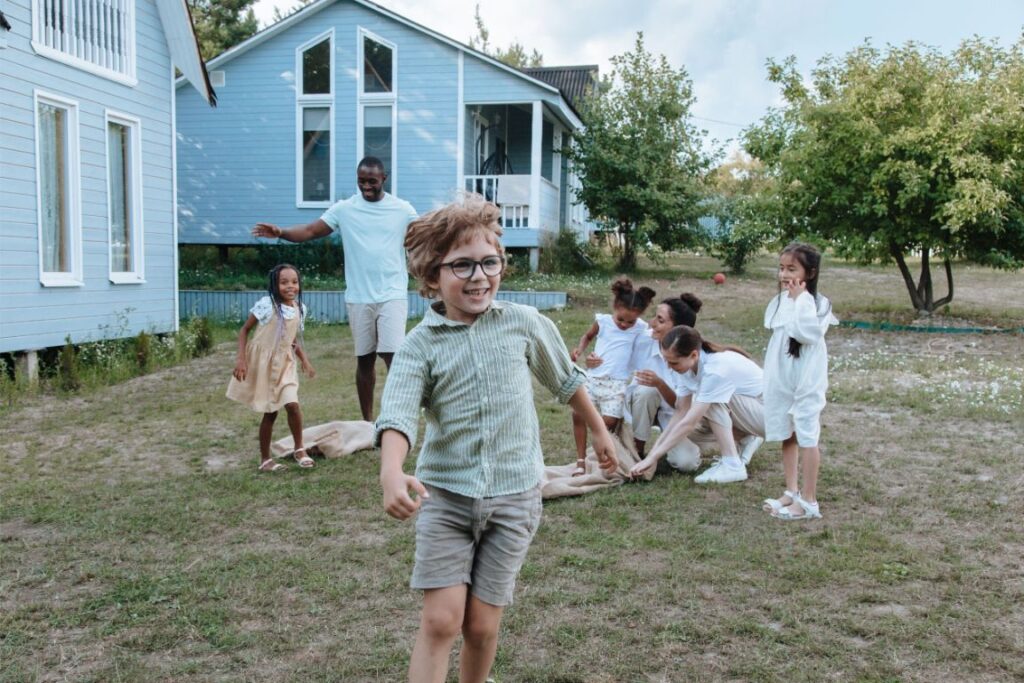
Each player stands in a sack or pillowcase and hops to the finish line. Falls are inevitable, laughter is guaranteed.
Three-Legged Race
Players pair up and tie adjacent legs together with a scarf or ribbon. The pair must coordinate their movement to reach the finish line. Coordination dissolves quickly and the result is usually very funny.
Treasure Hunt
Prepare clues in advance, each leading to the location of the next. The final clue leads to a small prize. Works for all ages with the complexity of clues adjusted accordingly. Takes preparation but produces an extended, engaged activity.
Outdoor Games for Older Kids and Tweens (Ages 9 and Up)
Rounders
An English summer classic. A batter hits a ball bowled underarm and runs around a series of posts. Fielders try to get the ball to a post before the batter reaches it. A full game needs at least eight players and a decent outdoor space.
Kubb
A Swedish throwing game using wooden blocks. Teams take turns throwing batons to knock over the opposing team’s wooden blocks. The team that knocks over the King (a large central block) last wins. A garden set is inexpensive and the game has enough strategy for adults and older children to find it genuinely engaging.
Boules or Pétanque
Players throw metal balls attempting to land them as close as possible to a small target ball (the jack). The player or team with the ball closest to the jack scores. Highly portable, works on most surfaces and is one of the few outdoor games adults will play as enthusiastically as children.
Swing Ball
A ball on a string attached to a pole. Two players use bats to hit the ball in opposite directions, attempting to wind it completely around the pole. Simple, competitive and compact.
Tips for Encouraging Children to Play Outside
Let Boredom Happen First
Children who are bored outdoors are more likely to invent play than children who are immediately supplied with an activity. The discomfort of having nothing to do often produces creativity. Give it five minutes before intervening.
Have Equipment Visible and Accessible
A ball in a bag in the garage is a ball that does not get used. Equipment that is visible, accessible and easy to retrieve gets used. A simple outdoor storage box or a few hooks on a fence changes how often children reach for outdoor play materials.
Rotate What Is Available
The same equipment produces the same play. Rotating what is available outside (a chalk bag one week, a water table the next, bubbles the week after) keeps the outdoor environment feeling fresh.
Go Outside With Them
Children play more and for longer when an adult is present and engaged, even if the adult is not actively playing. Sitting outside with a cup of tea while children play is enough. Your presence signals that outside time is valued time.